Public safety / Undeclared conflict
The War Beneath Our Bins
Leaking bin? Do not smell it. Do not touch it. For the love of public infrastructure, do not hose it.
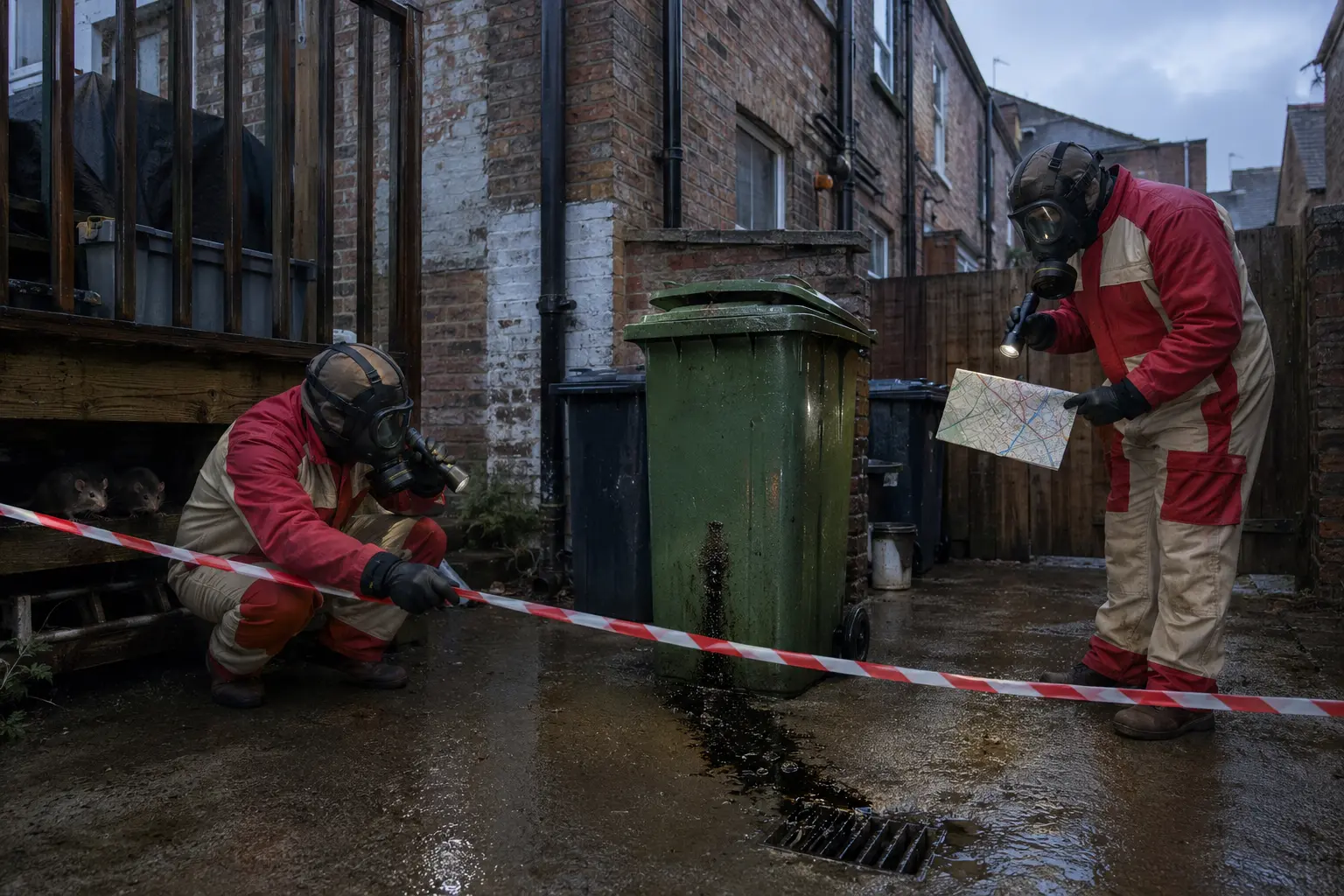
The report
It usually begins with a puddle.
Small. Dark. Easily ignored.
Perhaps you notice it beneath the wheelie bin while leaving for work. Perhaps there is a smell. Perhaps something moves behind the fence.
Most people continue with their day.
According to Bite-Back Pest Control, this is the first mistake.
Because beneath Britain's bins, behind its takeaway shops and somewhere underneath that decking you keep meaning to replace, a war is being fought.
And Bite-Back believes we are losing.
Know Your Enemy
Nobody is certain when Bite-Back stopped describing rats as pests and began describing them as “hostile subterranean actors.”
Company literature suggests the change happened gradually.
Early Bite-Back advertisements offered conventional pest-control services.
Rats.
Mice.
Wasps.
The occasional squirrel whose intentions could not immediately be established.
Then came the bin-juice campaign.
Bite-Back began warning households that leaking refuse wasn't simply unpleasant.
It was an invitation.
According to the company, bin juice provides rats with three things essential to establishing what its literature calls an “operational foothold”:
food, water and confidence.
The third is apparently the dangerous one.
“A hungry rat is a pest,” one Bite-Back training document reportedly states.
“A hungry rat is a pest. A confident rat has objectives.”
— Extract recovered from the case file
DO NOT HOSE IT
Bite-Back's advice for anyone discovering an unidentified liquid beneath their bin is unusually specific.
Do not smell it.
Do not touch it.
And under absolutely no circumstances should you hose it into the street.
The company claims that water merely spreads what it calls the “nutritional theatre of operations.”
One contaminated puddle becomes three.
Three become a trail.
The trail reaches a drain.
After that, according to Bite-Back, “we're into infrastructure.”
Precisely what happens once rats gain access to infrastructure is less clear.
Bite-Back's public-information films tend to cut away at this point.
Usually to a flag.
The War Beneath Us
For decades, pest control operated according to a simple principle.
Humans lived above ground.
Rats lived below it.
Occasionally the two sides encountered one another and somebody phoned a man with a van.
Bite-Back believes this arrangement has collapsed.
Modern rats, the company warns, are better fed, increasingly organised and displaying what one spokesperson described as “a worrying familiarity with municipal layouts.”
Bins provide food.
Drains provide transport.
Sheds provide cover.
Decking provides forward operating bases.
Compost bins remain, in Bite-Back terminology, “politically complicated.”
The company's more dramatic educational material depicts Britain's sewer network as an enormous underground front line.
Critics have accused Bite-Back of exaggerating the threat to sell pest-control services.
Bite-Back strongly denies this.
It also sells an emergency package.
They Bite. We Bite Back.
Bite-Back built its reputation on aggressive branding.
Its original slogan — “They Bite. We Bite Back.” — appeared on vans, uniforms and a series of public-information posters that looked sufficiently official for several councils to reportedly receive complaints about them.
But the company eventually decided even that slogan was too complicated.
Today, Bite-Back's philosophy can be reduced to four words:
WE JUST GAS ’EM.
The slogan has been criticised by environmental groups, animal-welfare campaigners and at least one person from the company's own marketing department.
Bite-Back remains committed to it.
A spokesperson said the phrase reflects the organisation's dedication to “clear communication during periods of heightened rodent activity.”
The same spokesperson declined to explain what constitutes heightened rodent activity.
He did, however, advise us to check behind the bins.
The Bin-Juice Question
At the centre of Bite-Back's campaign is an uncomfortable truth.
Nobody likes bin juice.
Nobody wants to discuss bin juice.
And almost nobody knows exactly what bin juice is.
It exists somewhere between liquid and consequence.
A combination of rainwater, food waste, split bags and decisions made earlier in the week.
For rats, however, it may as well be gravy.
Bite-Back claims that unattended leakage can attract rodents from what it describes as a “surprisingly ambitious radius.”
Once one rat arrives, others may follow.
Once several arrive, Bite-Back recommends no longer referring to the situation as “a rat.”
Terminology escalates quickly from there.
A group becomes an infestation.
An infestation becomes an incursion.
An incursion becomes a front.
If somebody from Bite-Back uses the phrase “active theatre,” you are advised to go indoors.
Reports From the Front
Residents across the country have reported increasingly bold behaviour.
Bin lids disturbed overnight.
Refuse bags opened from underneath.
Small holes appearing beside fences.
One homeowner reported making prolonged eye contact with a rat that appeared “completely unbothered by the situation.”
Bite-Back classifies this as intimidation.
Another claimed a rat remained stationary while he repeatedly stamped his foot.
Bite-Back classifies this as a failure of deterrence.
A third reported seeing two rats apparently working together.
Bite-Back would not comment on operational matters.
None of these incidents prove the existence of the organised rodent campaign described in company literature.
They have nevertheless been added to the map.
There is apparently a map.
We have not been allowed to see it.
What Should You Do?
Despite the military language, Bite-Back insists householders should not attempt to engage rodents themselves.
The public is instead encouraged to secure rubbish, clean spills safely, keep bin lids closed and contact appropriate pest-control services when there are signs of infestation.
This is the most conventional advice Bite-Back offers.
It rarely lasts.
One company leaflet follows these instructions with a picture of a rat beneath the words:
HE KNOWS WHERE YOU SLEEP.
Another depicts a leaking wheelie bin illuminated like a battlefield at dawn.
Bite-Back maintains that these materials are educational rather than alarmist.
Is There Really a War?
Probably not.
At least not in the conventional sense.
There are no recognised front lines.
No rat government has issued demands.
No evidence has emerged of a functioning rodent command structure.
And despite repeated claims from Bite-Back promotional material, there remains no confirmed instance of a rat deliberately targeting critical national infrastructure.
Bite-Back argues that this is exactly the sort of complacency the rats are relying upon.
Perhaps the truth is less dramatic.
Britain has bins.
Britain has rats.
Occasionally one leaks near the other.
But late at night, when something scratches behind the fence and the security light flickers on, even the most sceptical homeowner may find themselves remembering Bite-Back's warnings.
So if you discover a dark puddle underneath your wheelie bin tomorrow morning, remain calm.
Do not smell it.
Do not touch it.
And whatever you do—
do not hose it towards the drain.
Because it might only be bin juice.
But Bite-Back has already added your street to the map.