Hidden history / Scotland desk
The Traffic Cone Conspiracy
Professor Duncan returns to explain why Scotland’s most famous crown has spent centuries sitting on the wrong head.
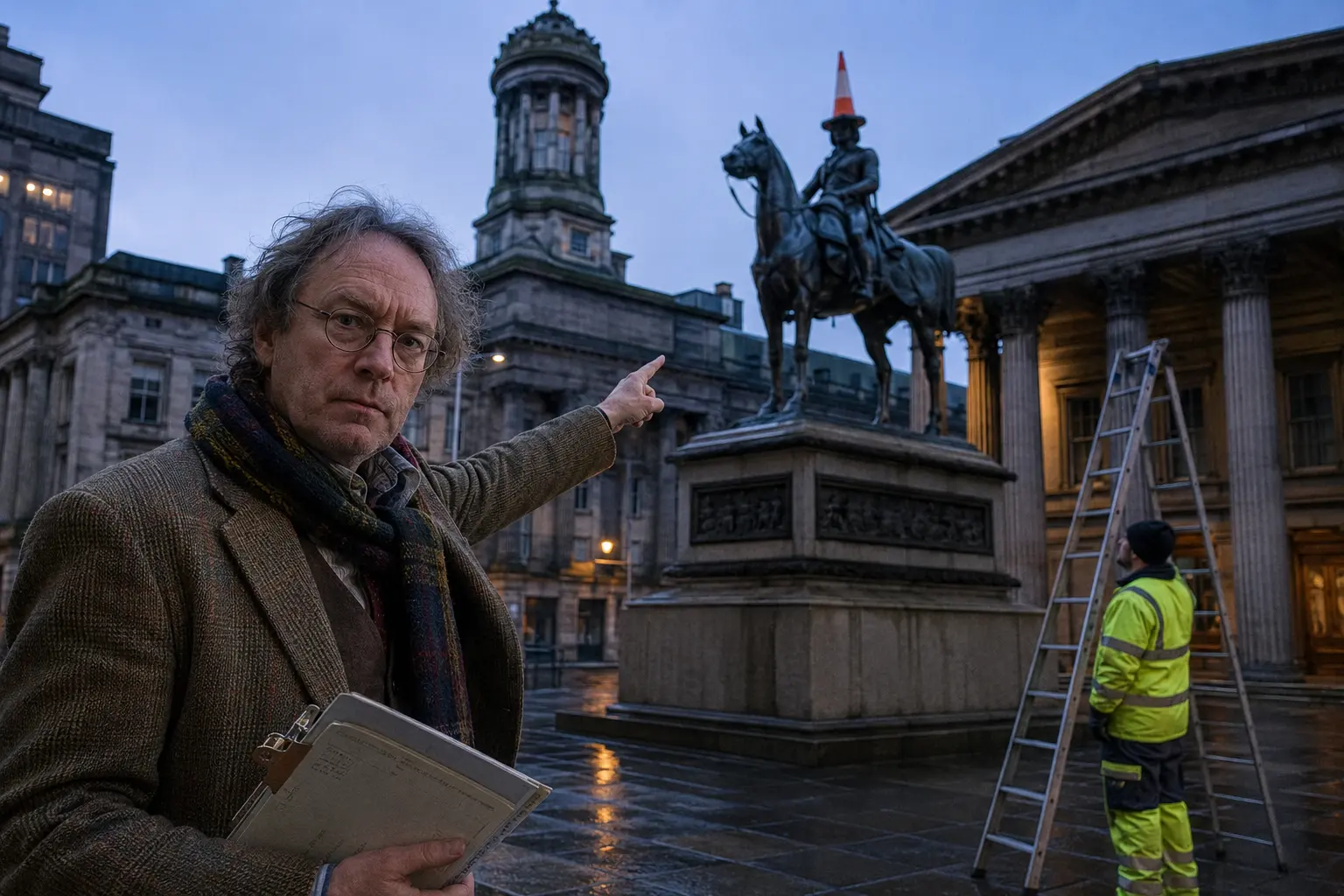
The report
For decades, Glasgow has been accused of putting a traffic cone where it doesn't belong.
Professor Duncan believes we have this precisely backwards.
According to new research presented as part of Alba X-Treme's Scotland's Hidden History, the orange-and-white cone sitting atop the Duke of Wellington statue isn't the product of late-night drunken ingenuity.
It isn't even particularly modern.
It may be the surviving symbol of a Scottish tradition stretching back almost 5,000 years — one that survived Roman occupation, medieval warfare, Victorian urban planning and repeated intervention by Glasgow City Council.
And if Duncan's most controversial conclusion is correct, the cone hasn't simply survived.
In 1869, we built one 220 feet tall.
We just haven't realised it yet.
Glasgow, Wellington and the Question of Why
Stand outside Glasgow's Gallery of Modern Art and look upwards.
There is the Duke of Wellington.
And there, inevitably, is the cone.
Thousands of visitors photograph it every year.
Council workers have removed it.
Police have discouraged people from climbing up to replace it.
Glasgow has responded in the manner to which authorities have eventually become accustomed.
It puts it back.
The accepted history is relatively straightforward.
Sometime during the late twentieth century, somebody decided Wellington would look better wearing road furniture.
Other Glaswegians agreed.
A tradition was born.
Professor Duncan — historian, broadcaster and a man Alba X-Treme describes simply as “our expert” — says that explanation is no longer sufficient.
“The question,” Duncan explains, “was never why Glasgow started doing it.”
A pause.
“The question is why Glasgow remembered.”
“They couldn't keep the cones off.”
— Extract recovered from the case file
The 1887 Cone
The first problem appeared in 1994.
During excavation work beneath Glasgow, archaeologists reportedly uncovered an unusual object buried within Victorian earth.
Battered.
Degraded.
But unmistakable.
A traffic cone.
Dated to 1887.
This presented historians with a difficulty, principally because nobody was supposed to be putting traffic cones on statues in 1887.
Researchers began revisiting Victorian photographs previously considered unremarkable.
Then somebody noticed it.
In the background of one image, sitting proudly upon the head of a municipal statue, was a familiar conical shape.
Contemporary newspaper reports provided something even stranger.
They referred to the practice as:
“The Crowning.”
Authorities condemned it.
Police attempted to prevent it.
People put the cone back.
More than a century before Glasgow City Council found itself engaged in the same apparently unwinnable struggle with Wellington, Victorian Glasgow had already fought the battle.
And lost.
For Professor Duncan, this was only the beginning.
The Auchtermuchty Manuscript
The next discovery pushed the practice backwards not decades, but centuries.
The Auchtermuchty Manuscript, believed to date from around 1320, contains an illustration that had puzzled scholars for generations.
A small figure can be seen carrying a conical object.
Traditional interpretations described it as a ceremonial hat.
Duncan initially accepted this explanation.
Then another page was examined.
There, in an illustration overlooked for centuries, stood a monument.
On its head:
the same object.
“It wasn't a hat,” Duncan says.
He offers no further explanation.
He doesn't appear to feel one is necessary.
The Orange Crown of Humiliation
Six years before the Auchtermuchty Manuscript was supposedly created, Scotland had fought one of the defining battles of its history.
Bannockburn.
In 1314, Robert the Bruce's forces defeated the army of Edward II.
Generations of historians have examined accounts of what followed.
Professor Duncan is interested in one passage in particular.
According to the account, Bruce ordered his men to place upon a captured monument:
“the orange crown of humiliation.”
Duncan believes this is the earliest written description of what modern Scots would recognise as coning.
The authenticity of the passage remains disputed.
Principally, Duncan notes,
by England.
Rome Had a Cone Problem
The trail does not stop in medieval Scotland.
Nearly a thousand years earlier, Roman forces advancing into Caledonia began recording a curious local practice.
Monuments erected north of the frontier were repeatedly found altered.
Objects had been placed upon their heads.
Conical objects.
Again.
And again.
And again.
Rome responded as Rome often did.
It sent more men.
That didn't work.
So they built a wall.
That didn't work either.
Eventually, Rome withdrew.
Traditional historians cite military pressure, geography, economics and the considerable difficulty of maintaining control over northern Britain.
Professor Duncan believes another possibility has been neglected.
“They couldn't keep the cones off.”
Whether this materially contributed to Rome's strategic withdrawal remains the subject of some disagreement.
Mostly from historians.
2,800 BC
For any conventional historical investigation, Roman Scotland would have been an entirely respectable place to stop.
Professor Duncan kept going.
Then came 2019.
During an archaeological excavation, an object was recovered from beneath almost five thousand years of Scottish soil.
It stood approximately 47 centimetres tall.
It was carved from local stone.
Its shape was unmistakably conical.
More remarkably, analysis detected traces of ancient pigment.
Researchers reconstructed its probable original appearance.
Orange.
Around its centre ran a pale band.
There was a long silence when Professor Duncan presented the reconstruction.
Carbon dating placed the object at approximately:
2,800 BC.
This predates the modern traffic cone.
By some margin.
Exactly what prehistoric Scots used the object for remains unknown.
Duncan believes its purpose is obvious.
Conventional archaeology does not.
Relations between the two are understood to have deteriorated.
Then He Looked at Stirling
The prehistoric discovery should have been Professor Duncan's conclusion.
Instead, it caused him to look again at something considerably larger.
High above Stirling stands the National Wallace Monument.
Completed in 1869, the Gothic tower commemorates William Wallace and has dominated the landscape for more than 150 years.
Millions have seen it.
Few have apparently asked Professor Duncan's question:
Why is it that shape?
His investigation led to what he describes as the most compelling evidence yet for Scotland's forgotten relationship with the cone.
Victorian architectural documents connected to the monument refer to inspiration from what architect John Thomas Rochead allegedly called:
“the ancient crown of the Scottish people.”
Then Duncan found the early designs.
The original proposal was considerably simpler than the monument standing today.
No elaborate Gothic crown.
No decorative complexity.
Just one enormous tapering stone structure rising above Stirling.
A cone.
Approximately 220 feet high.
Visible for miles.
A permanent monument to what Duncan believes Victorians still understood to be an ancient symbol of Scotland.
The design was rejected.
Officially, the reason was aesthetic.
Unofficially, Queen Victoria is said to have taken a less architectural view of the proposal, describing it as:
“an absolutely enormous nuisance.”
A compromise followed.
The monument was redesigned.
Gothic details were added.
The shape became more respectable.
But underneath it all, Duncan argues, the original idea survived.
The cone remained.
It was simply disguised.
Scotland's Largest Traffic Cone
Viewed alongside Duncan's evidence, the resemblance becomes difficult to unsee.
The prehistoric stone cone.
The medieval illustrations.
The Victorian designs.
The modern traffic cone.
And finally, standing high above Stirling:
the Wallace Monument.
Professor Duncan's conclusion is characteristically restrained.
“We've spent 150 years calling it a monument.”
He looks towards the tower.
“It is a monument.”
A pause.
“To the cone.”
According to Duncan, Scotland's most famous traffic cone therefore isn't sitting on Wellington's head at all.
It's standing outside Stirling.
Wellington merely wears the portable version.
The Custodians
Which brings us back to Glasgow.
Late at night, someone approaches the Duke of Wellington carrying a traffic cone.
They climb.
They place it on his head.
By morning, thousands of people walk past without giving it a second thought.
Perhaps it is vandalism.
Perhaps it is drunkenness.
Perhaps Glasgow simply enjoys watching public authorities lose arguments with street furniture.
Professor Duncan offers another possibility.
Those making the climb aren't inventing anything.
They are custodians.
The latest generation entrusted with an ancient responsibility they no longer consciously understand.
The Romans tried to stop it.
Medieval kings embraced it.
Victorian police tried to stop it.
Queen Victoria apparently objected to an extremely large one.
Glasgow City Council tried to stop it.
The result has remained remarkably consistent.
The cone went back.
Empires have risen.
Kings have fallen.
Nations have changed.
The cone remains.
And perhaps somewhere beneath five thousand years of Scottish history lies the explanation for why.
Or perhaps, sometime tonight, somebody in Glasgow will leave a pub, see Wellington's bare head and think:
That needs a cone.
Either way, by morning,
it probably will.
Alba X-Treme field notes
Professor Duncan's investigation features in Alba X-Treme's Scotland's Hidden History: The Traffic Cone.
Sponsored by ALBA X-TREME — FORT WILLIAM
Preserving Scotland's heritage by climbing things we've been repeatedly told not to.
PLEASE DO NOT CLIMB THE DUKE OF WELLINGTON STATUE.
Alba X-Treme's insurers were very clear about this.