MERINGUE! Volume I
#001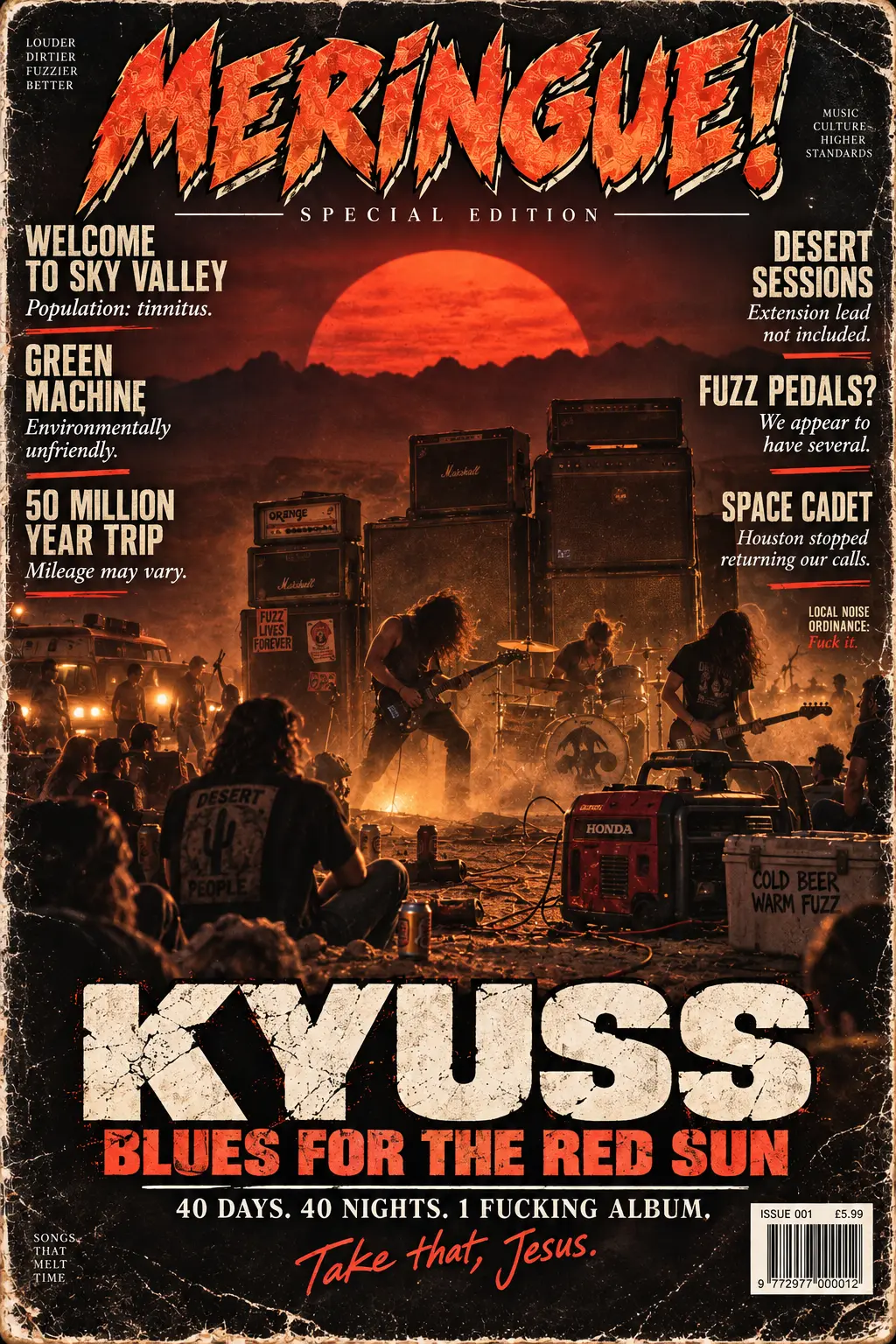
Kyuss
Blues for the Red Sun
“Jesus spent 40 days and 40 nights in the desert and came back with nothing. Kyuss came back with a f**king album.”
Dali Records • 1992
There are heavy albums, and then there are albums that appear to have been recorded underneath something heavy.
Blues for the Red Sun is the latter.
Released in 1992, Kyuss’ second album arrived from Palm Desert, California, sounding almost completely detached from what was happening elsewhere in American rock. Seattle had grunge. Los Angeles had spent the previous decade applying hairspray industrially. Meanwhile, four young men in the California desert were plugging enormous amplifiers into petrol generators, playing parties in the middle of nowhere and developing a sound resembling the Earth clearing its throat.
Nobody sat down and decided to invent “desert rock”. That came later.
Kyuss were simply playing the music that made sense where they lived.
And Christ, did it make sense.
The difference is obvious within seconds of Thumb.
Josh Homme’s guitar doesn’t really crunch. It rumbles. Downtuned and pushed through a setup designed to emphasise the bottom end, it occupies a strange territory somewhere between guitar, bass and approaching geological event. Underneath it, bassist Nick Oliveri and drummer Brant Bjork don’t merely provide a rhythm section; they make the entire record swing.
That groove is important.
Because for all the discussion of how heavy Kyuss were, Blues for the Red Sun isn’t fifty minutes of four blokes attempting to flatten you.
It moves.
Green Machine follows, written by Bjork, and remains perhaps the most immediate demonstration of what made this band special. Bjork reportedly introduced the song to John Garcia in his bedroom, effectively showing him both the song and how he wanted it delivered. Years later, Bjork would describe it as political.
Which means one of the definitive songs of desert rock began with a drummer sitting on a bed going, essentially:
Right, John. Sing it like this.
Rock history can occasionally be disappointingly efficient.
Garcia absolutely sells it. His voice is enormous without becoming polished, sitting above the low-frequency carnage like a man shouting directions from the roof of a collapsing building.
Then something interesting happens.
Kyuss start wandering.
Molten Universe is instrumental. 50 Million Year Trip (Downside Up) stretches towards six minutes and moves through several different moods rather than simply repeating the trick that made Green Machine work. The latter eventually drifts away from its initial weight into something hazier and almost weightless.
This is where Blues for the Red Sun becomes much more interesting than the thousands of records subsequently described as “stoner rock”.
Kyuss understood space.
Producer Chris Goss understood it too.
After the comparatively rough Wretch, Goss helped capture something much closer to the actual Kyuss experience. Much of Blues for the Red Sun was performed live in the studio, with Garcia later recalling that there are probably mistakes still sitting on the record. Instrumental passages including Apothecaries’ Weight, Caterpillar March and Molten Universe grew naturally from the band’s tendency to jam.
Nobody appears particularly worried about making everything perfect.
Thank fuck.
Because perfection would have ruined it.
The record breathes precisely because you can hear four musicians reacting to each other rather than four immaculate performances being assembled into a product.
And then there’s Thong Song.
A song about footwear.
Not metaphorical footwear.
Not “the sandals represent the crushing inevitability of mortality”.
Footwear.
This is an album that would go on to influence an entire branch of heavy music, and one of its better-known songs concerns the simple pleasure of wearing thongs.
MERINGUE! respects this enormously.
From there, Apothecaries’ Weight melts into another great instrumental excursion before the tiny Caterpillar March wanders past and leads into the album’s great voyage, Freedom Run.
At seven-and-a-half minutes, it should drag.
It doesn’t.
The riff gradually becomes somewhere to live. Bjork and Oliveri lock underneath Homme while the guitar alternately pushes forward and disappears into psychedelic space. This is perhaps the secret ingredient everyone who subsequently bought a fuzz pedal after hearing Kyuss occasionally missed: the heaviness wasn’t the destination.
The groove was.
Little fragments such as 800 and the acoustic Capsized prevent the record from ever becoming one continuous wall of brown noise, while Writhe and the charging Allen’s Wrench remind you that punk remains somewhere in Kyuss’ bloodstream.
Then Nick Oliveri gets the keys.
Mondo Generator closes the record sounding considerably less interested in behaving itself.
The title has its own beautifully stupid piece of Kyuss mythology: Brant Bjork had spray-painted “MONDO GENERATOR” onto Oliveri’s amplifier. Oliveri used the phrase for the song and would eventually use it again as the name of his post-Kyuss band.
Most musicians spend weeks brainstorming band names.
Brant Bjork apparently just vandalised Nick Oliveri’s equipment.
Again: efficient.
What makes all this even more absurd is how young they were.
These aren’t weathered desert veterans documenting decades spent beneath an unforgiving Californian sun. They were barely into their twenties when Blues for the Red Sun appeared.
Yet the record already sounds fully inhabited.
There are traces of Sabbath, punk, psychedelia and blues throughout it, but none completely explains Kyuss. Homme himself wasn’t the Sabbath obsessive people assumed him to be; the band’s members came from a broader collision of punk and alternative influences. The resulting music therefore didn’t feel like four young men attempting to recreate the 1970s.
It sounded like four young men who had accidentally found something of their own.
The rest of the world eventually noticed.
Blues for the Red Sun wasn’t some gigantic commercial breakthrough. Its reputation grew afterwards. Kyuss would tour with bigger bands, their influence would spread, and the album would increasingly be recognised as one of the defining heavy records of its era.
Its fingerprints are now everywhere.
Every downtuned desert-rock riff.
Every sun-bleached psychedelic jam.
Every band photograph involving four men standing beside a suspiciously old van.
Somebody, somewhere, owes Kyuss money.
More importantly, though, Blues for the Red Sun still works after you remove its historical importance.
You don’t need to know what it influenced.
You don’t need to care what genre somebody eventually filed it under.
You don’t even need to own a fuzz pedal.
Put on Thumb.
Turn it up.
The explanation arrives shortly afterwards.
Thirty-four years later, Blues for the Red Sun still sounds hot, loose, enormous and slightly dangerous — a record born from a bunch of young musicians playing obscenely loud music in a place where there was nobody around to tell them they couldn’t.
Jesus may have had the wilderness.
Kyuss had generators.
We know which one made the better record.
If you disagree, please write to MERINGUE! Complaints Department. Your correspondence will be left somewhere outside Palm Desert and powered by a generator.